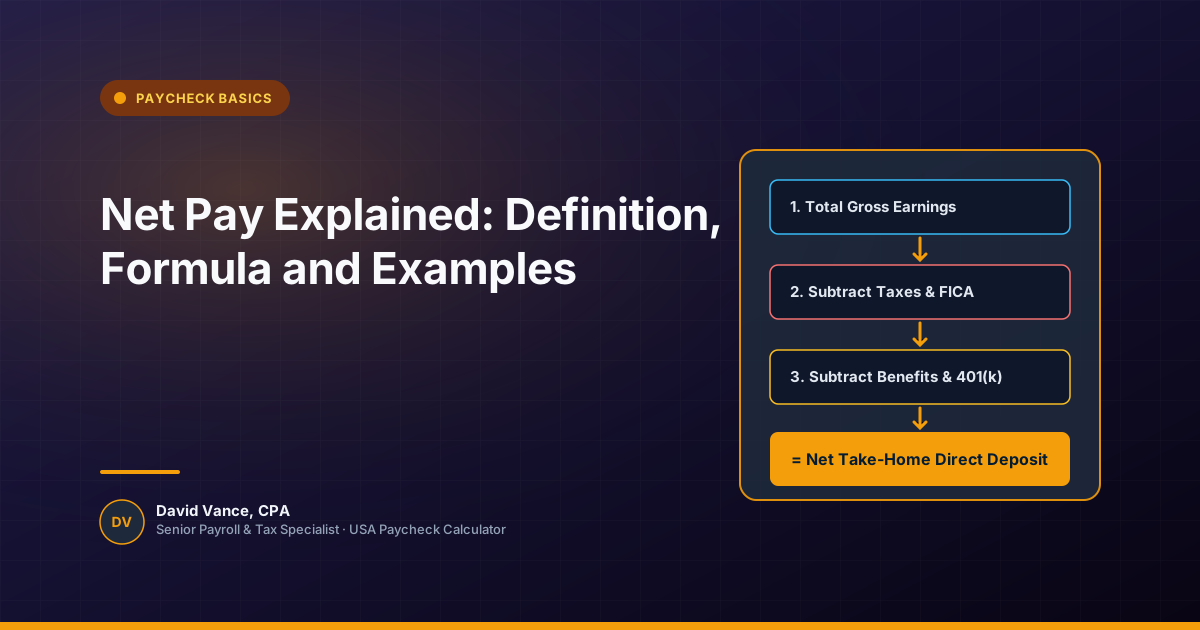
Step-by-Step Breakdown of the Components
The basic relationship is:
Net pay = gross pay − taxes − deductions The formula is useful because it shows what to investigate when your paycheck changes. If gross pay stayed the same but net pay fell, something below gross pay changed. That could be withholding, benefits, retirement contributions, a garnishment, a payroll correction or another deduction.
Taxes, Deductions, and Adjustments
Consider a simplified example. Suppose a worker has $3,000 of gross pay for a pay period. If payroll withholds $350 for federal income tax, $186 for Social Security and Medicare combined, $150 for state tax, and $200 for benefits and retirement contributions, the remaining net pay would be $2,114. This is an illustration of the mechanics, not a prediction of what a particular worker's taxes should be.
The reason a simple percentage can be misleading is that payroll deductions do not all follow the same rules. Social Security has an annual wage base; Medicare does not. Federal income-tax withholding depends on the worker's W-4 information and payroll period. State and local rules vary. Benefits can also change taxable wages.
For 2026, Social Security withholding is 6.2% for the employee up to $184,500 of covered wages. Medicare is 1.45% with no wage-base limit, and Additional Medicare withholding of 0.9% begins once an employer pays an employee more than $200,000 in wages during the year.
Estimating and Verifying Your Paycheck
That creates an important paycheck-reading habit: don't compare only the final number. Compare the components.
If this week's net pay is lower, check gross earnings first. Then compare federal withholding, state or local taxes, FICA, retirement, insurance and other deductions with the previous statement. A change in one line often explains the whole difference.
A paycheck calculator can help you model that process before payday. But its result should be treated as an estimate unless it has access to the exact payroll inputs used by your employer. Your pay stub is the record of what payroll actually did; the calculator is a way to understand and plan around the calculation.